Friday, April 18, 2008

Chinese Room: Kitchen Rebuttal

Can a computer simulation of a mind seem so real as to understand language? John Searle, a professor of philosophy at UC Berkley, doesn’t seem to think so. He tried to refute any possibility of Artificial Intelligence with his Chinese Room argument.

Chinese Room Argument


From the outside the Chinese Room passes the Turing Test, in which an outside interrogator cannot distinguish between the hidden occupant of a room being a human or a machine. To perform the test, the outside interrogator, fluent in Chinese, writes messages in Chinese and passes them into the room. Responses, in Chinese, are eventually retrieved from the room which the interrogator evaluates and becomes convinced that the occupant of the room does in fact ‘understand Chinese.’

At this point, Searle asserts the Chinese Room passes the Turing Test. However, unbeknownst to the interrogator, inside the room John Searle himself performs all the work. Searle asserts that he does not understand Chinese. He takes written input from the outside, consults rule books, and uses scratch paper to figure out what actions to perform. The rule books contain a computer listing for an artificial intelligence program. Searle follows the program that culminates with output in Chinese that he sends out of the room.

Now here’s the kicker. Searle asserts that both before and after the exercise he does not ‘understand Chinese,’ and furthermore he asserts that the artificial intelligence program does not understand Chinese either, since he performed all the work inside the room. Therefore, Searle asserts, claims to artificial intelligence are refuted.

Chinese Kitchen Rebuttal


Upon cross examination, let’s get specific and say the Chinese Room in question is a kitchen. The Chinese Room is a Chinese Kitchen in a Chinese Restaurant. To begin with the waiter writes up a customer order, which he passes into the Chinese Kitchen. As stipulated, Searle is in the Chinese Room. He looks at the order and, as stipulated, it’s written in Chinese; but Searle, as stipulated, doesn’t understand Chinese. So, as stipulated, he consults a rule book.

The first rule book he consults is the menu. Every entrée on the menu lists the name of the dish in Chinese, the name in English, and the price. Ignore the price. It’s irrelevant to the cook. Using the menu, he tries to match the Chinese characters on the order with the Chinese dish names on the menu. Even if Searle doesn’t understand Chinese he can distinguish similar character patterns from different character patterns. From the Chinese characters Searle identifies the English dish names.

Just out of curiosity, if who’ve ever eaten at a Chinese restaurant, then have you ever bothered to learn the Chinese characters for the dishes you ordered? Me neither, and we can assume that Searle hasn't either.

At this point, Searle consults another rule book. It’s written in English so he can understand it, as stipulated. The next rule book he consults is a cookbook, from which he prepares the dishes according to recipes he finds by their English names. When Searle is done cooking, he passes the dishes out of the Chinese Kitchen for the waiter to serve to the customer. As stipulated, the output of the Chinese Room is in Chinese, Chinese food in this case.

According to the Turing Test the proof is in the tasting, ‘the customer is always right.’ If Searle performed an accurate impersonation of a competent chef, then most customers will be satisfied that Searle ‘understands Chinese’ in the cooking sense and leave a tip. Otherwise the dishes will be sent back to the kitchen. But according to Searle’s Chinese Room argument we should trust his self-evaluation of his ability to simulate artificial intelligence or in this case a cook. How good a cook John Searle rates himself remains an open question, but should we trust his opinion or the customer’s? That’s debatable. However the following conclusion is irrefutable.

As stipulated, at the end of the experiment, Searle asserts that he does not understand Chinese. Is this true? Let’s find out. So at the end of his shift, Searle exits the kitchen and encounters the waiter who strikes up a conversation in Chinese, but Searle doesn’t understand a word of Chinese. Therefore Searle concludes that he never learns to understand Chinese from his experience in the Chinese Room, which is true with qualifications.

Deaf Chef Clarification

In fact, the way the Chinese Room thought experiment is constructed, Seale never has a chance to understand Chinese any better than a deaf chef. So what does this mean? It means that if you didn’t understand from the beginning that the meaning of the phrase ‘understand Chinese’ in the Chinese Room argument really meant to ‘understand Chinese no better than a deaf chef’, then you either misunderstood or were mislead into misunderstanding the Chinese Room argument. Is that insight clear? The Chinese Room argument depends on an interpretation of the word ‘understand’ that seems familiar. However, once the correct interpretation is exposed through rigorous cross examination, then the Chinese Room argument loses sensibility. That is normally what happens with fallacious rhetorical arguments.

We all have a familiar sense of what it means to ‘understand Chinese,’ which involves auditory communication. However, this is incongruent with the best possible outcome of the Chinese Room argument, which is to ‘understand Chinese no better than a deaf chef.’ Agreement with the premise and conclusion of the Chinese Room argument depends upon our sustaining the initial incorrect belief. Once we become aware of this incongruence then the suspension of disbelief bubble bursts.

Saturday, June 16, 2007

Micro ART Review

If a male is an electron, then electrons repel each other, but together they perform work in the form of electricity. If women are protons then women form nuclear bonds with other women and couples. Couples are neutrons, which are the combination of an electron plus a proton plus an antineutrino. An antineutrino is therefore love.

The half life of a neutron is the amount of time a couple remains together or until at least one half of the partners becomes disaffect and the relationship deteriorates. Unconditional love is a neutron with an infinite half life. A mother and a son also form a neutron.

Beta decay is the decay of a neutron into a proton and an electron. When a boy reaches puberty he tends to go his own way and the bond with his mother weakens.

Girlfriends form nuclear bonds. A mother daughter pair forms a nuclear bond.

The Oedipus story can be modeled in this way. The father feels threatened by his son. A prophesy claims that the son will displace the father, so the father sends the son away to his death. Oedipus does not die, but is adopted, grows up, leaves home, and meets his biological father on the road, where he slays him. In time he marries his mother.

A neutron is formed by one and only one pair of an electron and a proton. The idea is sound, but in real life the parent's intimate relationship resumes once the kids are asleep in bed. Instead of all or nothing, the mother/wife has two roles.

Another Greek myth is that of Odysseus, who goes off to the Trojan War leaving his wife Penelope and young son Telemachus. The war lasts ten years, and is recounted in Homer's Iliad. It took him another ten years to get home as recounted in Homer's Odyssey. By then Telemachus was twenty. When Odysseus returns he fights and kills Penelope’s suitors. Other stories say that Odysseus and Penelope have another son, and Odysseus leaves home again. As a corollary to the Oedipus complex, I offer the Penelope complex where the birth of a son displaces the husband in his relationship with his wife, and drives him away.

I define a neutron relationship, as an intimate relationship between a man and a woman. A hydrogen atom also contains an electron and a proton, but they are not as strongly bound as they are in a neutron. Statistics show that half of all hydrogen atoms end in ionization, i.e. half of all marriages end in divorce.

More Atomic Relationship Theory

Wednesday, May 9, 2007

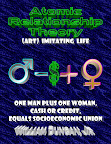
Atomic Relationship Theory

How do you describe a picture to a blind person? Searching for common ground and struggling to communicate through analogies must suffice. Imagine that someday we encounter an advanced alien race like the Asgard from the SciFi Channel series Stargate SG-1. This technologically advanced race reproduces through cloning. They fully comprehend mathematics, physics, chemistry, and electronics; but they fail to fathom, on any basis whatsoever, human relationships.


You independently decide you’ll attempt to bridge this communication gap. Your breakthrough comes when you consider subatomic particles, the constituents of matter. Electrons are small and mobile like male sperm. Protons are more massive like female ova, and protons are located in the atomic nucleus like a social unit. Not only do you find this analogy intriguing. In fact, it proves compelling and you’ve discovered a profound paradigm for understanding human relationships.

So you create cross reference dictionaries between physics and human relationships, based upon subatomic particles. In addition, you craft an algebraic notation, employing logical operations from mathematics, to encode the dynamics of human relationships on a micro scale. Furthermore, you develop cross reference dictionaries between chemistry and human relationships, based upon atomic elements and molecular bonds, to describe human social units on a macro scale, while producing cross reference dictionaries between electronics and human relationships to cover workplace interactions. As an extension you discover analogies to successfully explain the dynamics of more complex human relationships involving belief systems.

Your efforts exceed all expectations. Truth is more elusive than a needle in a haystack; since both the needle and the haystack are invisible, where truth’s concerned. However; once you’ve grasped the truth it’s generally quite simple, and powerful beyond belief. Ascending to the peak of a mountaintop, your perspective becomes unobstructed in all directions. This view is truly awesome. Let’s ask our friends to come join us. Shall we?

More Atomic Relationship Theory

Monday, February 26, 2007

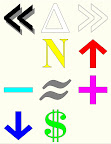
Primordial Construct: Chemistry

Exothermic
«
Heat
Δ
Endothermic
»

Gas
N
Molecules
Plasma
Bonds
Liquid
+
Atoms
Solid
$

Tuesday, February 13, 2007

Gistmass Ubiquity Theory

A comparative analysis of paradigms, from ancient through modern sources, reveals a unified, ubiquitous pattern underlying reality. At the core of existence, one elemental set of building blocks appears pervasive, and research indicates that many generations have interpreted and transcribed this primordial structure into transformative, progressive, cultural contexts.

A paradigm, in its own terms, explains or describes aspects of common experience from a unique perspective - like trying to reconstruct a statue from a collection of blurry snapshots. How many photographs, or video segments, are adequate to fully capture a family vacation, a day in the news, the year in review, a lifetime of memories, or a person’s character? Absolute truth may ultimately prove elusive. Increasing detail amounts to overload at the expense of general comprehension. Paradigms help us recognize the universal in the wild.

A collection of pictures taken from various viewpoints increases the recorded detail of a statue, like the opinion of a jury. By comparing and combining multiple paradigms, a universal pattern emerges through reinforced similarities, lending fresh insights into the big picture, into ourselves, and into the fabric of existence. These sources arise from diverse fields of study, and cover disciplines in human nature and in the nature of reality.

As children we learn language. We notice patterns. Regularities get reinforced. As we master patterns of speech, our communication skills grow and our understanding improves. Common ground gets established, and we learn to express our needs with greater eloquence and efficiency.

Paradigms facilitate our ability to communicate novel concepts and develop mutual understanding. Gistmass Ubiquity Theory supplies the framework that not only governs the universe but ourselves as well.

More Gistmass Ubiquity Theory

Sunday, February 11, 2007

Primordial Construct: Evolution

Ancestors
«
Living
Δ
Descendants
»

Genotype
N
Environment
Modification
Natural Selection
Inheritance
+
Individual
Phenotype
$

Charles Darwin's Theory of Evolution

    1. Decent with Modification
    2. Natural Selection

Tuesday, February 6, 2007

Primordial Construct: Politics

Status Quo
«
Reform
Δ
Perfect Union
»

Ideology
N
Liberal
Special Interests
Bipartisanship
Majority Rule
+
Conservative
Issues
$

Political Spectrum

Precedence
«
Laws
Δ
Principles
»

Judiciary
N
Anarchy
Executive
Democracy
Legislative
+
Monarchy
Constituency
$

Government Field